In aerospace and medical manufacturing, precision is everything. Every component must perform flawlessly under demanding conditions where even the smallest deviation can lead to failure. That’s why the choice between CNC machining and screw machining isn’t just a technical preference, as it’s a strategic decision that affects cost, reliability, and scalability.
If you’re sourcing precision parts or planning your next production run, understanding the strengths of each process can help you make the right choice for your components.
Understanding the Core Difference
Both procedures use material removal to produce a final product, but they are made for different manufacturing ideologies. This involves:
CNC Machining
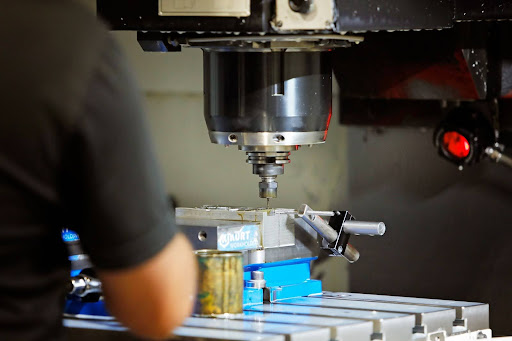
This is built around precision and flexibility. Using advanced CAD/CAM software and 3-, 4-, or 5-axis configurations, CNC machines can mill, drill, and contour complex geometries in a single setup. They can handle intricate part features, tight tolerances, and difficult materials while maintaining consistent accuracy across every cut.
Screw Machining
Focusing on speed and volume, these automated lathes use multiple cutting tools at once to shape bar stock into finished parts, often in seconds. Multi-spindle systems like Davenport machines work on several parts simultaneously, making them ideal for high-volume production of small, precision-turned components.
Key Decision Factors for Your Component
Your part’s design, material, and required volume will point to the optimal process. Ask these four questions to guide your decision.
Production Volume
When choosing between CNC and screw machining, the size of your production run plays a key role. CNC machining works best for prototypes, small batches, or parts that need frequent design updates. It offers flexibility and precision for runs ranging from one unit to a few thousand.
Screw machining, on the other hand, is ideal for high-volume production, typically in the tens of thousands or more, where speed, repeatability, and cost efficiency matter most. It’s the better choice for long-term manufacturing of consistent, precision parts. If your production needs grow over time, shifting from CNC to screw machining can lower your per-part cost while maintaining reliable quality.
Part Geometry and Design Complexity
The shape and design of your part largely determine which machining process delivers the best results. CNC machining handles complex geometries with ease, making it ideal for components with multiple surfaces, curves, or deep cavities, such as aerospace brackets, manifolds, and surgical handles. Its multi-axis capability allows for precise cutting of intricate, non-rotational shapes.
When parts are primarily round or cylindrical, screw machining offers greater efficiency. It’s designed for producing high volumes of shafts, pins, fittings, and valves with exceptional speed and consistency. While it can perform added features like threading or cross-drilling, its true strength lies in the rapid, repeatable production of precision round components.
Material and Tolerance Considerations
Both methods are fully capable of holding extremely tight tolerances. The decision often hinges on the material and the consistency required. Tight tolerance CNC machining is frequently the go-to process for exotic alloys like Inconel, titanium, and medical-grade PEEK. This is where the controlled, programmable toolpaths manage heat and tool wear meticulously.
Screw machining, however, offers remarkable dimensional repeatability over large quantities. This provides incredible consistency for materials like stainless steel (300 & 400 series), aluminum, brass, and copper.
Cost, Lead Time, and Project Flexibility
The total cost of production involves more than the price per part; it also includes setup, tooling, and scalability. CNC machining keeps initial costs low by relying on programming instead of custom tooling, making it ideal for prototypes and small runs that need quick turnaround. As volumes grow, though, its per-part cost rises.
Screw machining takes more setup time and tooling investment upfront, but becomes far more efficient at scale. Once production starts, it delivers faster cycle times and lower per-part costs, making it the better choice for high-volume manufacturing.
Ready to find your ideal production solution? With expertise in both technologies, CAR Stamping and Machining provides a balanced, data-driven approach to manufacturing precision components for aerospace, medical, and optics applications. Contact us to request a quote to optimize your manufacturing outcomes today!